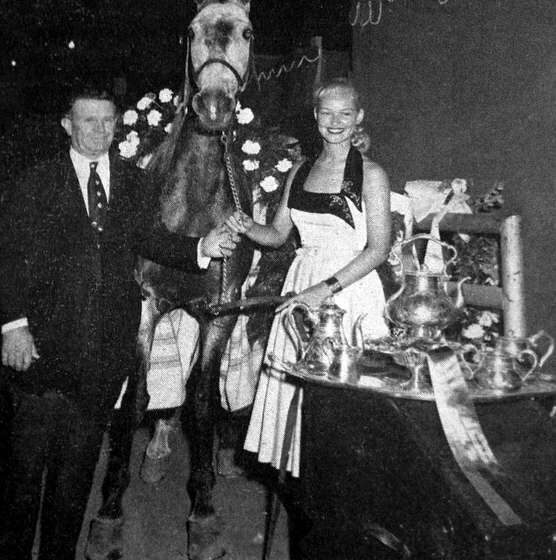

Joan Robinson Hill’s death in 1969 led to one of Houston’s most widely known criminal cases, involving multiple autopsies, a rare murder charge, a mistrial, the later killing of her husband and convictions connected to that killing.
Hill was born Feb. 6, 1931, in Houston and was adopted as an infant by oilman Davis Ashton “Ash” Robinson and his wife, Rhea. She grew up in a prominent Houston household and became known in the city’s social and equestrian circles.
She began riding as a child and later competed nationally on American Saddlebred horses. Her best-known horses included Beloved Belinda and Precious Possession. Her equestrian career made her a familiar figure in Houston’s horse-show world before her death became the subject of criminal investigation.
In 1957, she married Dr. John Hill, a Houston plastic surgeon. Hill was born in Edcouch and studied at Abilene Christian College before attending Baylor College of Medicine in Houston. He completed a surgical residency at Hermann Hospital and later practiced plastic surgery.
The couple had a son, Robert Ashton Hill, in 1960. In 1965, they bought a Southern colonial-style home at 1561 Kirby Drive in River Oaks.
The house later became closely associated with the case. During the marriage, it was also known for an elaborate second-floor music room John Hill built for concerts and gatherings. Hill was a musician and played several instruments.
By 1968, the Hills’ marriage was under strain. John Hill was involved with Ann Kurth, and he and Joan separated before later reconciling. Accounts of the period describe disputes over the affair, finances and the music room.
In March 1969, Joan became ill at the Kirby Drive house. Her symptoms included nausea, vomiting and diarrhea. She was taken to Sharpstown General Hospital on March 18 and died early March 19. She was 38.
The medical cause of death was not resolved in a straightforward way.
Texas law required an autopsy because she died in a hospital within 24 hours of admission. Her body was removed from the hospital and embalmed before the first full autopsy was completed, complicating later examinations.
Several autopsies and reviews followed. Findings pointed to a severe infection, but the source could not be determined. Harris County Medical Examiner Joseph Jachimczyk later described the cause as a fulminating infectious process whose specific nature was no longer determinable.
Ash Robinson rejected the early explanations for his daughter’s death and pushed Harris County authorities to investigate John Hill. Prosecutors presented the case to multiple grand juries before Hill was indicted in 1970.
The charge was commonly described as murder by omission. Prosecutors alleged that Hill, as a physician, failed to provide adequate medical care for his wife while she was seriously ill. He was not convicted.
Hill’s trial began in February 1971. Ann Kurth testified against him and made claims that went beyond the omission theory, including allegations that Hill had confessed to killing Joan. The testimony created a legal problem for the prosecution because the indictment was based on failure to provide care, not direct poisoning.
Hill’s attorney, Richard “Racehorse” Haynes, requested a mistrial. The request was granted.
A second trial was scheduled for 1972. It did not take place.
On Sept. 24, 1972, John Hill was shot and killed at the Kirby Drive house after returning home with his third wife, Connie. The killing led to another criminal investigation.
Bobby Wayne Vandiver was later arrested and indicted in Hill’s death. Authorities said Vandiver described the shooting as a contract killing. He was killed in 1974 during a confrontation with police in Longview before his trial.
Marcia McKittrick and Lilla Paulus were later convicted in connection with Hill’s murder. McKittrick was convicted as the getaway driver and received a 10-year sentence. Paulus received a 35-year sentence and died in prison in 1986.
The case received continued public attention after the prosecutions. Journalist Thomas Thompson wrote about it in the 1976 book “Blood and Money.” The case later became the basis for the 1981 television film “Murder in Texas” and has been revisited in documentaries and true-crime programs, including KTRK’s “Texas Mansion Murder.”
The house at 1561 Kirby also remained part of the public story. KTRK reported that later owners Robin and Danny Klaes preserved the music room and embraced the home’s history before listing it for sale.
The case remains notable in Houston history because of the number of legal and medical questions involved. Joan Robinson Hill’s exact cause of death was not conclusively identified. John Hill was indicted and tried but not convicted. His later killing resulted in convictions, though public interest in the case continued long after the trials.
More than five decades later, the story remains closely tied to Joan Robinson Hill, the Kirby Drive house and a sequence of events that moved from private illness to public investigation, courtroom proceedings and homicide.